
In Vedic astrology, the birth chart shows the potential areas of life, while Mahadasha and Antardasha help astrologers understand when certain planetary influences are likely to become more prominent. This planetary timing system is an important part of Vimshottari Dasha, one of the most widely used Dasha systems in Vedic astrology.
Understanding your current Dasha can provide a framework for analysing periods related to career, marriage, finances, business and personal development.
What Is Mahadasha in Vedic Astrology?
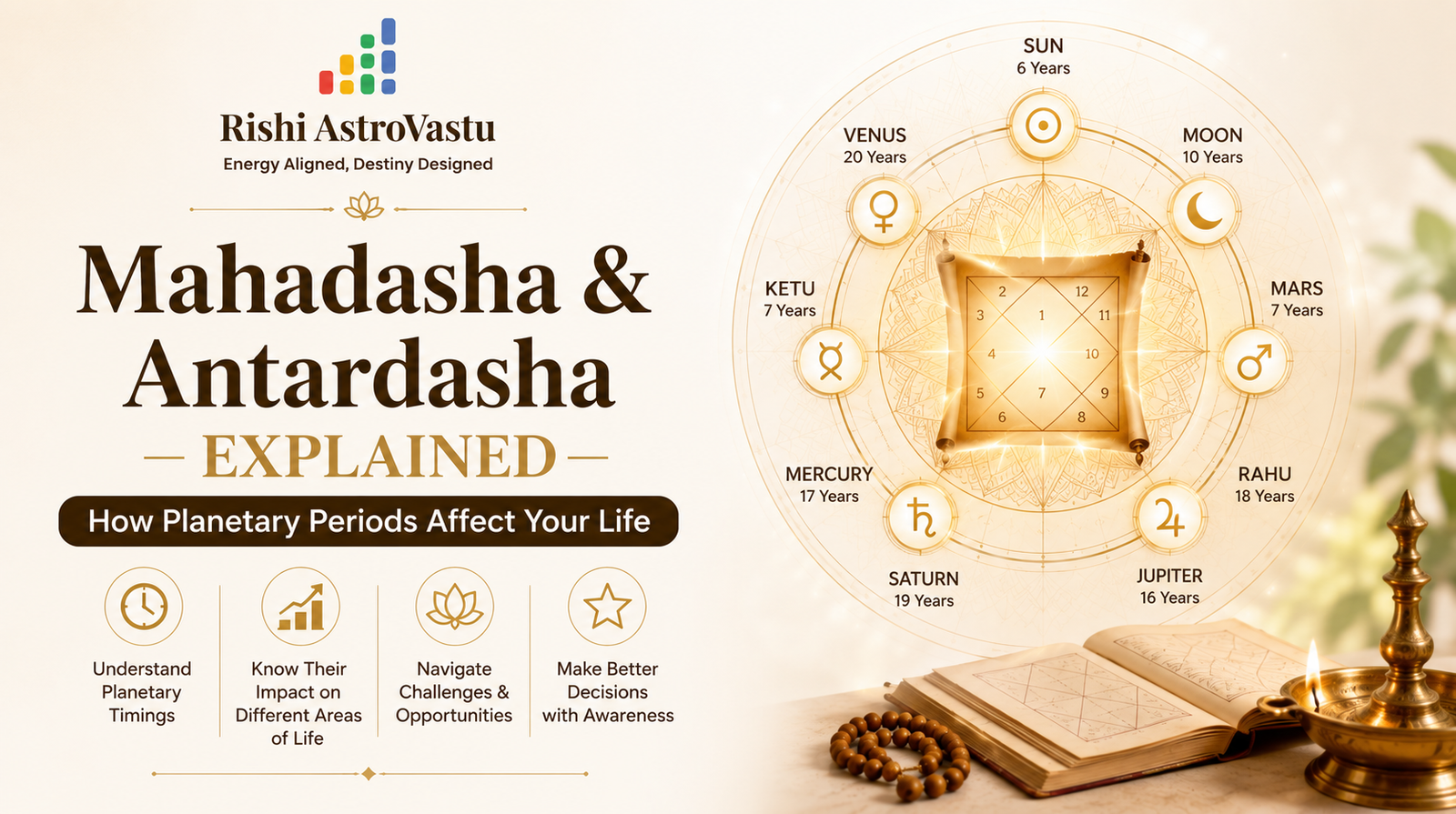
Mahadasha means the major planetary period. In the Vimshottari Dasha system, each of the nine planetary influences is assigned a specific period.
The durations are traditionally:
- Sun – 6 years
- Moon – 10 years
- Mars – 7 years
- Rahu – 18 years
- Jupiter – 16 years
- Saturn – 19 years
- Mercury – 17 years
- Ketu – 7 years
- Venus – 20 years
Together, these periods form a 120-year cycle.
The Mahadasha planet becomes an important factor in interpreting the experiences and themes of that period. However, its results depend on its house placement, sign, lordship, strength, aspects and relationship with other planets in the birth chart.
What Is Antardasha?
An Antardasha is a sub-period within a Mahadasha. For example, a person may be running:
Jupiter Mahadasha → Venus Antardasha
Here, Jupiter represents the broader period, while Venus modifies the specific themes and experiences during that sub-period.
This is why two periods within the same Mahadasha can feel quite different.
How Do Dashas Affect Your Life?
Planetary periods may be analysed in relation to different areas of life.
Career & Business
The Dasha of planets connected with the 10th, 6th, 7th or 11th houses may become important for professional developments, employment, business or income.
Marriage & Relationships
The 7th house, Venus, Jupiter and relevant planetary periods are commonly examined when analysing marriage timing and relationships.
Wealth & Finances
The 2nd and 11th houses, their lords and relevant planetary periods can be considered when studying financial opportunities and gains.
Can a Mahadasha Be Good or Bad?
There is no universal rule that a particular Mahadasha is always good or bad.
For example, Saturn may produce discipline, responsibility and long-term progress for one person, while creating delays or pressure for another. Its results depend on the individual birth chart.
Therefore, interpreting a Dasha based only on the general nature of a planet can be misleading.
Mahadasha, Antardasha & Transits
For more detailed timing, astrologers may consider Mahadasha, Antardasha and planetary transits together. The birth chart indicates potential, while Dashas and transits can help identify periods when particular themes may become more active.
Final Thoughts
Mahadasha and Antardasha are important tools in Vedic astrology for understanding planetary timing. Rather than judging a period simply as positive or negative, the complete Kundli should be examined to understand how the active planets are connected with different areas of life.
At Rishi AstroVastu, personalised Vedic astrology consultations analyse the birth chart, planetary periods and relevant astrological factors to provide individual guidance for career, marriage, business and other important life decisions.
Disclaimer: Vedic astrology is a traditional belief system and is not scientifically proven. Astrological guidance should not replace professional medical, financial, legal or other expert advice.