A home is more than just a physical space. In Vastu Shastra, the layout, directions and placement of different rooms are traditionally considered important for creating a balanced and harmonious living environment.
If you are building a new home, buying a property or looking for ways to improve the Vastu of an existing house, understanding the basic principles of Vastu for home can help you make more informed decisions.
What Is Vastu Shastra for Home?
Vastu Shastra is a traditional Indian architectural system that considers factors such as directions, room placement, entrances, proportions and spatial arrangement.
The objective is traditionally to create harmony between the built environment and the natural elements.
However, Vastu should not be reduced to a simple list of rules. The complete layout, plot, entrance, surrounding environment and individual requirements should be considered together.
Vastu for Main Entrance
The main entrance is an important consideration in residential Vastu.
The direction and exact placement of the entrance should ideally be assessed according to the property’s layout and orientation. The entrance should be clean, well-maintained and free from unnecessary clutter.
Good lighting and an inviting entrance can also improve the overall appearance and usability of the space.
Vastu for Living Room
The living room is generally associated with social interaction, relaxation and family activities.
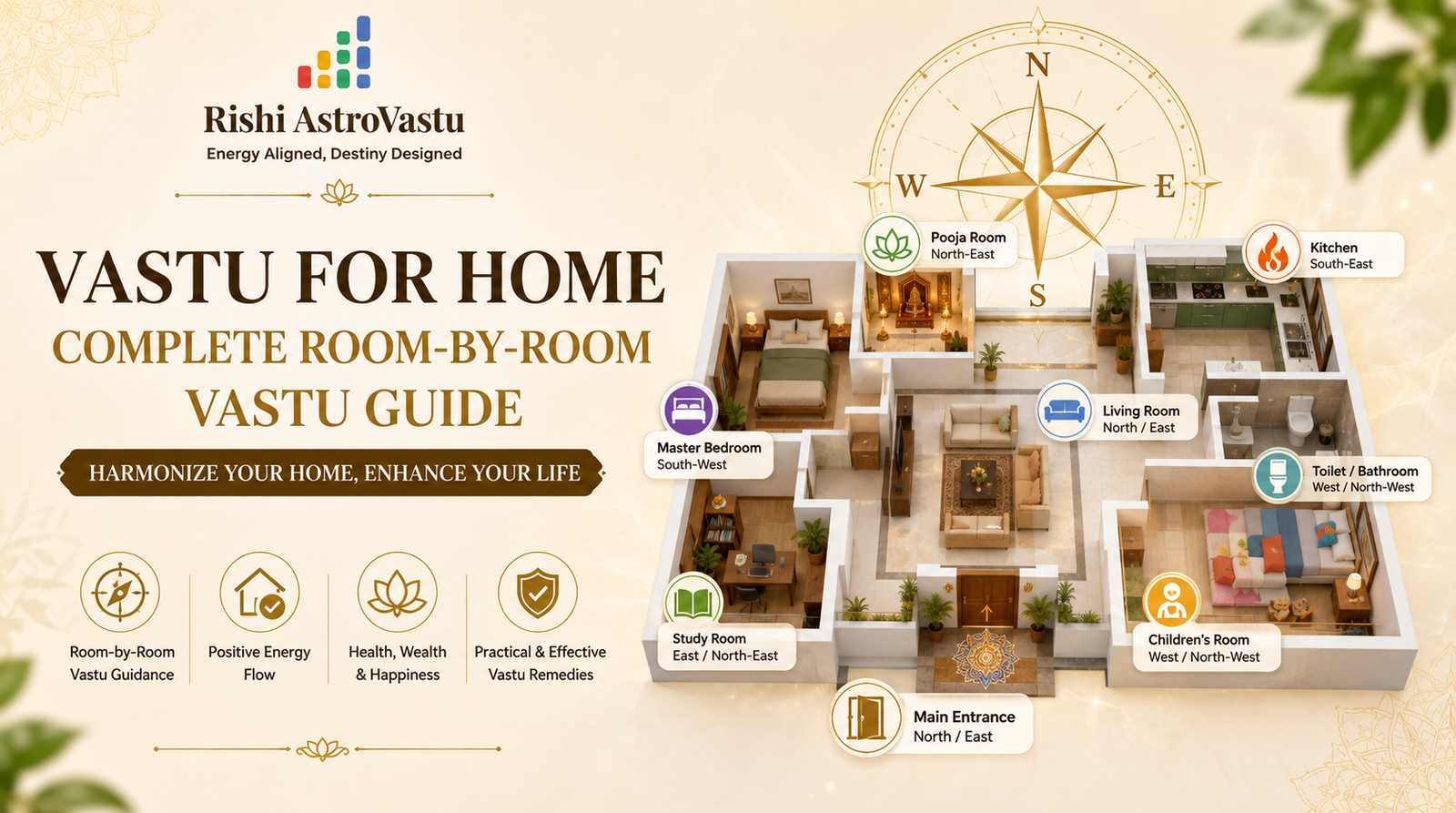
Traditionally, the north, east and north-east areas are often considered favourable for lighter and more open spaces, depending on the overall floor plan.
Furniture should allow comfortable movement, and unnecessary clutter should be avoided.
Vastu for Bedroom
Bedroom placement is particularly important for rest and privacy.
The south-west is traditionally considered suitable for the master bedroom in many Vastu guidelines. The bed should be positioned so that there is adequate space around it, and sleeping with the head toward the south or east is commonly recommended in traditional Vastu practice.
Vastu for Kitchen
The kitchen is traditionally associated with the Agni (fire) element.
The south-east is traditionally considered the preferred direction for a kitchen, while the north-west is often considered an alternative.
The stove and sink should ideally be planned with sufficient separation, while ventilation should be properly maintained.
Vastu for Pooja Room
A dedicated prayer or meditation area can provide a peaceful space within the home.
The north-east is traditionally considered an important direction for a Pooja room. The space should ideally be clean, peaceful and free from excessive storage.
Vastu for Bathroom and Toilet
Bathrooms and toilets require careful planning because their placement can affect the overall layout and functionality of the house.
Traditional Vastu guidelines commonly consider the north-west or west as suitable areas, depending on the floor plan and other site conditions.
Vastu for Study Room
A study room should encourage concentration and comfortable working conditions.
The east, north and north-east are traditionally associated with learning and knowledge. A well-lit, ventilated and organised study area is generally preferable.
Vastu for Children’s Room
For children’s rooms, traditional Vastu recommendations may consider the west, north-west or other suitable sectors depending on the child’s age and the overall floor plan.
More importantly, the room should provide good natural light, ventilation, sufficient storage and a comfortable study environment.
Vastu for Home Office
With more people working from home, a dedicated workspace has become increasingly common.
The north or east is traditionally considered favourable for a work area. The desk should allow comfortable seating and avoid blocking natural movement or ventilation.
Can Vastu Be Improved Without Demolition?
Yes. An important misconception is that every Vastu issue requires structural changes.
In an existing home, practical adjustments to furniture placement, clutter, lighting, colours, usage of spaces and specific Vastu remedies may sometimes be considered before undertaking major structural changes.
However, remedies should be selected according to the actual Vastu assessment rather than applying generic products or rules blindly.
Final Thoughts
A good Vastu for home approach should consider the entire property rather than judging individual rooms independently. The plot orientation, main entrance, room placement, proportions, natural light, ventilation and overall layout should be assessed together.
At Rishi AstroVastu, personalised residential Vastu consultations can help evaluate your home’s layout and provide practical recommendations, including solutions for existing properties where major structural changes may not be desirable.
Disclaimer: Vastu Shastra is a traditional Indian architectural and spatial-planning system. Its principles are not scientifically proven to predict health, wealth or other outcomes. Practical decisions involving construction, safety and structural changes should be taken with qualified professionals.